


EBEH: Easy, Build, Easy Hard, Repeat
👇 Get new sketches each week
A technique for training and life
EBEHs are a technique I use when pool swimming.
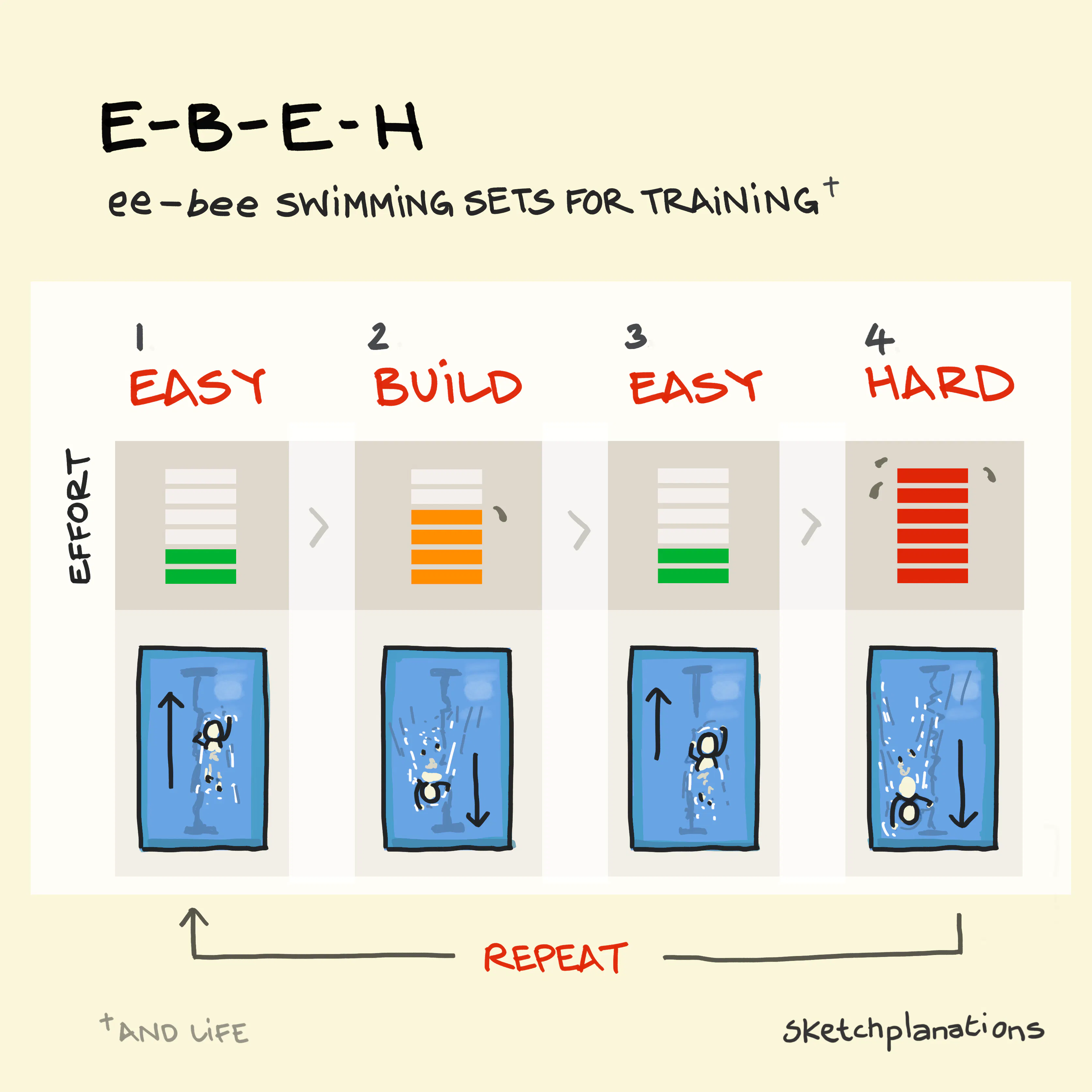
EBEH stands for Easy, Build, Easy, Hard
(I say it as ee-bees).
An EBEH means:
- Swim a length at an Easy pace
- In the next length, Build with increased effort
- Then drop back to the Easy pace
- Then give it a Hard, near all-out effort for the fourth length
Then repeat, straight back into an easy recovery.
Whenever I remember to swim EBEHs I think, “These are good for so many reasons.” If you’re training for something physical, they might help, and I find the principles that make EBEHs effective apply so well as an approach to many things in life.
Here are some of the principles that I think make EBEHs so good:
Break a large indeterminate goal into manageable chunks
Rather than thinking, I’ll swim for 40 minutes, or for 2km, I can just focus on completing my next EBEH.
The Hard lengths are hard, but the Build lengths get me ready for it. I know what’s coming next and can anticipate it.
Even when I'm just contemplating hard work, like going for a swim training workout, I find this helps me get going and keep going.
Track progress and know where you’re at
Rather than counting to, say, 10 lengths and losing count, with EBEHs I can always tell which part I’m on. Did I just sprint? If I’m swimming back, then I should be going easy.
Clear goals and immediate feedback are two of the conditions that help create flow. An endless, indeterminate path is hard to stay motivated for. With EBEHs, I always know what I'm doing now and what's coming next.
Intersperse effort with breaks
As in life, you can’t sprint all the time. If you’re always pushing hard, you burn out. You stop looking forward to the activity and start dreading and resenting it. But sometimes sprinting is a good thing.
With EBEHs, you build up to it. You sprint, but you know you’ll have a break on the other side. And then you do it again.
Many things in life are more like a marathon than a sprint. Planning periods of intense effort with breaks, I find, works really well.
Recover while still moving
One subtle effect of EBEHs I've noticed is that I rest without stopping completely—I recover while still swimming on the easy lengths.
If I were to just swim, then my rest would be stopping at the ends. But EBEHs encourage me to work hard and then catch my breath and recover on the nice easy lengths, ready to go again.
I’m not tempted to stop. I keep going and cover more as a result.
It’s similar to having run up a hill. You don’t want to run up so hard that you have to stop at the top. Can you run up so that at the top you slip back into your standard pace and recover while still running?
I’m not against stopping to rest—I love it!—but I find EBEHs raise my baseline and change what feels like rest. Easy swimming becomes recovery rather than something I need to recover from. For endurance, I like how it normalises keeping going.
Working in chunks makes progress add up quickly
An EBEH is a shorthand for four lengths. I don’t have to count individual lengths. I aim for 3 EBEHs and I know I’ll cover 12 lengths. Just a few more EBEHs and I’m at 20.
Progress feels faster when every one I count means I've actually done four.
If you’re training for something, maybe give EBEHs a try. And even outside training, I find the same pattern surprisingly useful. Is there anywhere you could apply the principles of EBEHs?
Related Ideas to EBEHs
Also see:
- Fast pool, slow pool
- Fartlek: alternating sprints while running
- Stand, Sit, Lie - for recovery
- Flow
- Anchors and tugboats
My training partner and I discussed this, and other things swimrun, on the Low Tide Boyz podcast - Plogging
- The virtuous cycle of exercise and sleep
- Run further by running further away
- Everything is aiming
I learned EBEHs from a good friend who I do swimrun with, who came across it on an old training plan. I did a lot of EBEHs recently, so they’ve been on my mind.